
FIRST CALL PLUMBING BLOG
5 Signs Your Water Heater Is About to Fail
★ 4.9-star service • Licensed & insured • Upfront pricing
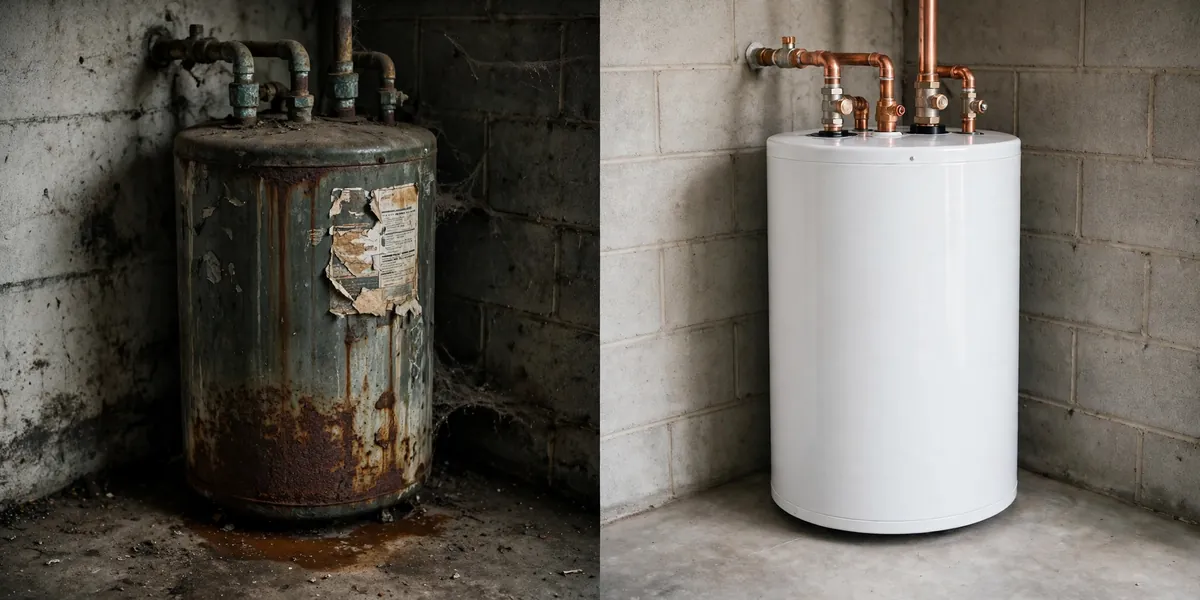
Old water heater before and new unit after replacement.
Water heaters rarely die quietly. They warn you first: strange noises, odd water, small puddles. The trouble is that most homeowners miss the warnings until the tank lets go and floods the garage.
In Commerce City, heaters face an extra enemy. For more than twenty years, local water ran at about 22 grains per gallon of hardness. That mineral load scaled up tanks from the inside.
The water supply was softened to about 7 grains per gallon in 2021, but two decades of scale already did their damage. If your heater is over eight years old, read on.
Why is my water heater rumbling or popping?
Rumbling or popping sounds mean sediment has built up on the bottom of the tank. Water trapped under that sediment layer boils and bursts through, which makes the noise. In Commerce City, the old 22 grain hard water left thick scale in tanks across the city, so this sound is common here.
A little sediment is normal and a flush can help. Heavy buildup is different. It forces the burner to run longer, overheats the tank bottom, and shortens the tank’s life.
If your heater rumbles loudly every cycle and is past the eight year mark, the tank is telling you its time is short. A plumber can assess whether a flush is still worthwhile or the tank is too far gone.
Why is my hot water rusty or discolored?
Rusty hot water usually means the inside of the tank is corroding. Every tank has a sacrificial anode rod that attracts corrosion so the tank wall does not have to. When that rod is fully eaten away, the tank itself starts rusting.
Rusty water from the hot tap only, with clear cold water, points squarely at the heater.
Check one thing first: fill a bucket from a hot tap. If the water clears after a few seconds, it may be sediment stirring up. If it stays rusty, the tank wall is failing.
Replacing the anode rod can buy time if caught early, but once rust shows in the water, replacement is usually the honest recommendation.
Why does the pilot light keep going out?
A pilot that will not stay lit usually means a bad thermocouple, a failing gas control valve, or a draft problem in the venting. The thermocouple is a small, inexpensive safety part, and replacing it is a straightforward repair. If a new thermocouple does not solve it, the gas valve itself may be failing.
Here is the practical rule: a thermocouple replacement on a younger tank is worth doing. A gas valve replacement on a tank past ten years usually is not, because you are putting a costly part into a tank that is already near the end. At that point, the money serves you better in a new unit.
What does moisture or pooling at the base mean?
Moisture at the base of the tank is the most urgent sign on this list. Small drips from fittings can be tightened, but water seeping from the tank body itself means the steel has breached. There is no repair for a cracked tank.
None. Patch kits and sealants do not hold against tank pressure.
If you see pooling water under the heater, treat it as an emergency in slow motion. Shut off the water supply to the heater, turn the unit off, and call a plumber the same day. A seeping tank can become a flooding tank without further warning.
How old is too old for a water heater?
Most tank water heaters last 8 to 12 years. In Commerce City, the hard water era pushed many toward the short end of that range. You can find your tank’s age on the serial number label: most manufacturers encode the month and year in the first digits.
If you cannot decode it, a plumber can in seconds.
Past year ten, every repair decision should include the replacement question. A twelve year old tank that needs a three hundred dollar repair is a bad bet. That same money applied to a new, efficient unit buys a fresh warranty and a decade of reliability.
Repair or replace: an honest breakdown
| Situation | Usually best | Why |
|---|---|---|
| Tank under 8 years, minor part (thermocouple, element, thermostat) | Repair | Plenty of life left; parts are cheap relative to a new tank. |
| Tank 8 to 10 years, sediment noise, no leaks | Flush and assess | A flush may buy a year or two; start budgeting for replacement. |
| Tank over 10 years, any major part failure | Replace | Costly parts in a dying tank rarely pay off. |
| Any age, tank body leaking | Replace | A breached tank cannot be repaired. |
| Rusty hot water, anode rod gone | Replace in most cases | Early catch can be saved with a new rod; visible rust usually means too late. |
On cost: as national benchmarks (Angi and HomeAdvisor 2026 figures), typical repairs run $200 to $600, standard tank replacement runs $1,200 to $3,500 installed, and tankless units run $2,500 to $4,500. Local pricing varies with access, venting, and code upgrades. Get a written quote before approving anything.
Frequently Asked Questions
Eight to twelve years is the standard range, and local heaters skew toward the lower end because of the pre-2021 hard water era. Tanks installed before the 2021 softening carry heavy internal scale. If your heater predates 2021 and is past year eight, have it inspected annually. Annual flushing helps newer tanks reach the full twelve.
Tankless units last about twenty years and never run out of hot water, but they cost roughly twice a tank install and need annual descaling, especially with any remaining mineral content in the water. They suit households with high hot water demand and space constraints. For most families, a quality tank unit remains the best value.
Using national benchmarks from Angi and HomeAdvisor 2026 data, expect $1,200 to $3,500 installed for a standard tank, depending on size, venting, and code upgrades. Tankless runs $2,500 to $4,500. These are national figures; your written quote is what matters. Be wary of any quote given without looking at your current setup.
Yes. Hard water leaves mineral scale on the tank bottom and heating elements. That scale insulates the burner from the water, so the tank overheats, wastes energy, and fails early. Commerce City ran about 22 grains per gallon for over twenty years, which is very hard. The 2021 softening to about 7 grains helps new tanks, but older tanks already carry the damage.
Have a Plumbing Question? Just Call.
One call. Upfront price. A plumber at your door fast.